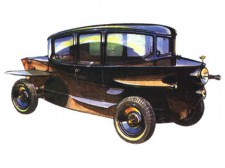
The Rumpler OA-104, designed by E. Rumpler (1872–1940), caused a sensation at the 1921 Berlin Motor Show. Its streamlined body, rear power unit and central steering wheel accompanied two vertically stacked headlights, six fan-arranged cylin...
Read more →
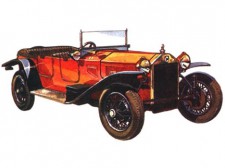
Unlike the Rumpler, this car did not shock buyers with its looks, but incorporated many innovations. Foremost was a unitary structure riveted from steel panels, with aluminium outer skin.
Read more →
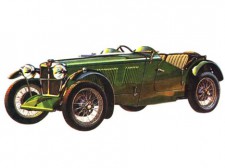
MG helped define the pre-war sports-car look. The illustrated J2 had wire wheels with central wing nuts, cycle wings, a windscreen folding onto the bonnet, cutaway doors and an upright fuel tank between body and spare wheel.
Read more →
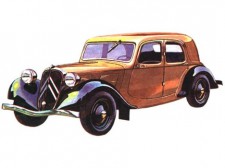
Traction Avant means front-wheel drive. This broad family was produced for 23 years with various bodies, three wheelbases (2,910, 3,090 and 3,270 mm) and four displacements of four- and six-cylinder engines (1,303, 1,628, 1,911 and 2,867 cm...
Read more →
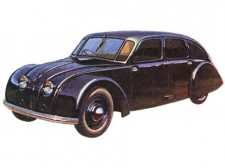
On 5 March 1934 Tatra presented journalists with a prototype of its radically new Type 77. The streamlined Tatra 77 combined a body without projecting running boards, a rear-mounted air-cooled engine, independent suspension on transverse le...
Read more →
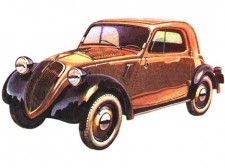
The Fiat 500 was a mass-produced pre-war small car. Its engine sat ahead of the front axle and the radiator above the clutch. It had independent front suspension and hydraulic brakes; the original calls it the first European model on 15-inc...
Read more →
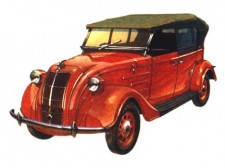
The loom-making company Toyota built its first car in 1935. Series production began in 1936; the original gives 1,404 AA saloons and AB phaetons under the Toyota name. Their design followed American practice, with styling variations on the...
Read more →
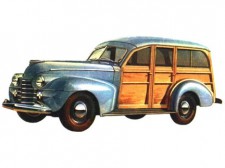
The Oldsmobile 8-90 pioneered a feature adopted by many American cars: an automatic hydromechanical transmission. Called Hydra-Matic, it combined a fluid coupling with an automatically controlled planetary gearbox. The illustrated Oldsmobil...
Read more →
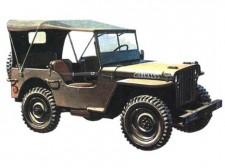
According to the original, Bantam specialists designed a four-wheel-drive command car with an open, doorless body in 1941. It carried 250 kg and could tow a light gun. The Bantam BRC entered service in 1942; Willys-Overland and Ford also re...
Read more →
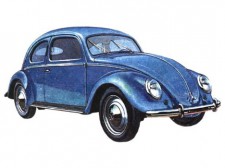
The car was designed and tested before the war. In 1937–1938 Daimler-Benz at Untertürkheim built two trial batches, of 30 and 60 Porsche-designed cars. Nazi authorities instead used the new Wolfsburg factory for military vehicles. Series Vo...
Read more →
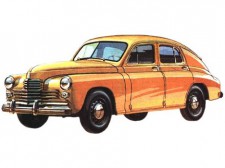
Prototypes of the GAZ-20, later named Pobeda, were built by November 1944, nine months after design began. A version of the six-cylinder GAZ-51 engine was initially planned; its differing figures are in brackets. The illustration shows a 19...
Read more →
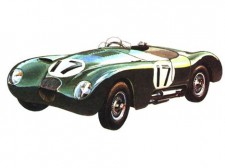
For competition, Jaguar built small batches of XK120-based cars called Jaguar K in the original, which explains the letter as standing for competition. They had welded tubular spaceframes, torsion-bar suspension on all wheels, rack-and-pini...
Read more →